
Collaborative Divorce Attorney | Texas

At Goranson Bain Ausley, our Collaborative Divorce attorneys help families across Texas resolve divorce outside of the courtroom — with privacy, dignity, and control over the outcome.
We guide couples through a structured, constructive process where both spouses work together with trained professionals to reach an agreement that protects their children, their finances, and their future.
Our Collaborative Divorce lawyers practice from offices in Dallas, Fort Worth, Austin, San Antonio, Plano, Flower Mound, Granbury, and Midland.
Your Collaborative Divorce Team
Collaborative Divorce brings together a team of professionals, each focused on a specific part of your case:
- Collaborative Divorce attorneys — trained to negotiate constructively and draft your final agreement, your attorneys advocate for your interests while working toward resolution.
- Financial neutral — organizes assets, debts, budgets, and property information so both spouses can make informed decisions about their financial future.
- Child specialist — a mental health professional who helps parents develop a parenting plan centered on their children’s needs and well-being.
- Divorce coach — supports you through the emotional side of the process, helping you communicate clearly and stay focused on reaching an agreement.
This team approach means each aspect of your divorce is handled by the right specialist — often at a lower cost than having your attorney manage everything.
Benefits of Collaborative Divorce
Collaborative Divorce offers advantages that traditional litigation cannot:
- Privacy and confidentiality — everything discussed stays between you, your spouse, and your professional team. Nothing becomes part of the public court record.
- Control over decisions — you and your spouse set the timeline, shape the agenda, and make the decisions that affect your family. No judge decides for you.
- Lower conflict — both parties commit to working constructively from day one, creating space for productive conversations instead of courtroom arguments.
- Cost efficiency — every dollar goes toward building your agreement, not preparing for a trial.
- Tailored solutions — without the constraints of a courtroom, you can design arrangements that fit your family’s specific situation.
How Collaborative Divorce Works
The Collaborative Divorce process follows a clear structure:
- You and your spouse each hire a Collaborative Divorce attorney. All parties sign a Participation Agreement, committing to resolve the divorce outside of court.
- Your team holds a series of meetings — typically two hours each — with agendas you help shape. Most cases resolve within four to six sessions.
- Neutral professionals join as your case requires. A financial professional can help organize complex assets or retirement accounts. A child specialist can help you build a parenting plan.
- Agreements are reached issue by issue. Nothing is final until every matter has been addressed and both parties approve a comprehensive settlement.
- Your Collaborative Divorce attorneys draft the final documents and file them with the court for approval.
Is Collaborative Divorce Right for You?
Collaborative Divorce works well when both spouses are willing to negotiate in good faith outside of court. It may be a strong fit if:
- You have children and want to maintain a healthy co-parenting relationship.
- You value privacy and want to keep your family’s matters out of the public record.
- You want to make decisions together rather than handing them to a judge.
- You’re looking for a process that’s less adversarial and more focused on moving forward.
If you’re unsure whether Collaborative Divorce is right for your situation, our attorneys can help you evaluate your options. Every family is different, and the right approach depends on your circumstances.
Work With an Experienced Collaborative Divorce Attorney
Goranson Bain Ausley has one of the largest teams of Collaborative Divorce lawyers in Texas. In the 2026 edition of The Best Lawyers in America®, 22 of our attorneys are recognized for Collaborative Law — and more than half of our firm is trained in collaborative practice.
Our Collaborative Divorce attorneys include Credentialed Collaborative Professionals and Board Certified family law specialists certified by the Texas Board of Legal Specialization. We bring both depth of experience and a genuine commitment to helping families find the best path forward.
From our offices in Austin, Dallas, Flower Mound, Fort Worth, Granbury, Midland, Plano, and San Antonio, we help clients protect their relationships and build a stronger foundation for what comes next.






















Collaborative Divorce Process FAQs
What is a Collaborative Divorce?
Collaborative divorce is a legal process that allows couples to resolve their divorce outside of court through structured negotiation rather than litigation.
Each spouse retains a collaboratively trained attorney, and the team typically includes neutral financial specialists and mental health professionals who work together to address the full scope of the divorce — from property division to co-parenting plans.
Because the process is confidential and built around problem-solving rather than adversarial tactics, it tends to produce more tailored agreements in less time than a traditional courtroom divorce.
When Is a Collaborative Divorce a Good Option?
For divorcing couples who want to maintain more control over the outcome of their divorce and prefer to avoid the courtroom, a Collaborative Divorce in Texas provides a viable alternative. People are generally more content with outcomes they help create, and those who opt for the collaborative model preserve their joint decision-making power rather than surrendering it to the court system.
Divorce is never pleasant, but it is possible to move out of the process without a lot of bitterness and resentment. This can make a collaborative law divorce especially appealing, especially if children of any age are involved and you have hope for a productive future co-parenting relationship.
How Does a Collaborative Divorce Work?
The signing of the Participation Agreement and the contractually agreed-upon boundaries that are put in place as part of Collaborative Divorce law serve to promote a safe environment that is characterized by confidentiality, mutual respect, and control over the outcome. At the same time, the threat of the courtroom is eliminated.
The participants’ specially trained Collaborative Divorce attorneys guide them through a series of scheduled meetings with pre-planned agendas, during which the participants work their way through the substantive issues that must be addressed and resolved. These structured steps form the foundation of the Collaborative Divorce process.
Issues unique to the participants, such as minor children, small businesses, retirement, or complex financial investments, can be addressed with or without the assistance of jointly engaged neutral professionals, such as child specialists, financial consultants, business valuation experts, estate planning professionals, and others. The participants themselves, with the counsel of their respective Collaborative Divorce attorneys, determine whether and when to involve such neutral parties.
Once a final agreement is achieved, the Collaborative Divorce lawyers will jointly draft the final documents and file them with the appropriate court for approval.
How Long Does a Collaborative Divorce Take?
The spouses in a Texas Collaborative Divorce participate in a series of pre-planned, face-to-face meetings with a team consisting of their Collaborative Divorce lawyers, a neutral mental health professional, and a neutral financial professional. The joint meetings are typically limited to two hours in length and occur on a schedule determined by the clients’ needs and desires. The average collaborative case usually resolves in four to six joint meetings. Any of the highly experienced Collaborative Divorce attorneys in our Austin, Dallas, Flower Mound, Fort Worth, San Antonio, Granbury, Midland, or Plano offices can help prepare you for the process and what to expect during these meetings.
What Is the Difference Between Collaborative Divorce and Mediation?
Although both Collaborative Divorce and divorce mediation are confidential, non-adversarial methods of resolving family law conflicts without going to court, the similarities end there.
Mediation is a process that typically takes place over the course of one or two days lasting up to ten to 12 hours. A neutral third person called a mediator meets privately with each party and their lawyer over the course of the day to gather information, explore options, and facilitate a binding agreement. If an agreement is reached, it is reduced to writing on the spot, and everyone signs the document before adjourning the session. If no agreement is reached, the process typically ends.
Mediation is an excellent settlement tool that is highly favored by both the courts and most lawyers because of its high success rate in resolving conflict without going to court. Unfortunately, mediation is most effective when used in the shadow of the courthouse. In other words, the optimal time to mediate arises only after the parties have already invested untold thousands of dollars and months of time litigating the conflict. By this point in the case, the parties are usually emotionally exhausted, financially drained, and yet still must face the prospect of a looming final trial date in the near future. This places tremendous pressure on both sides to make high-stakes decisions in an extremely compressed timeframe.
In stark contrast to traditional mediation, the Collaborative Divorce model completely eliminates the threat of the courthouse from the outset. Additionally, instead of creating a high-pressure environment near the end of the case in which the parties are required to make important decisions in one or two marathon sessions, the Collaborative Divorce model schedules multiple shorter meetings from the very beginning of the divorce. These meetings usually last no longer than two hours each and are spread out over several weeks, with Collaborative Divorce lawyers doing offline work behind the scenes in between each meeting. Each collaborative law divorce meeting has a pre-planned agenda that the parties themselves have a hand in setting, so there are no surprises during the meetings.
As tentative agreements are achieved, they are noted in the minutes of the meeting, but the parties are free to reconsider until all issues have been similarly addressed. At that point, a comprehensive and binding agreement is circulated. Only after all questions have been addressed satisfactorily do the parties bind themselves to the final, comprehensive agreement.
What Is Unique About Collaborative Divorce?
The Collaborative Divorce model is completely different than the traditional litigation model for divorce, and it is both established by and protected by Texas law. Once the spouses opt into the collaborative process by signing the Participation Agreement, the judge legally cannot interfere with the divorce process, except in very limited circumstances.
As long as the spouses choose to remain in the process, they remain the sole decision-makers. If either spouse decides to opt out of the process to return to litigation, both spouses must hire new trial attorneys, as the collaborative lawyers are required by Texas law to withdraw. Although most collaborative attorneys are also trial attorneys, they cannot serve in both roles in the same case.
This unique feature of the Collaborative Divorce model enables the whole process to work seamlessly because it keeps the interests of the Collaborative Divorce lawyer aligned with the client’s interests.
How Can a Collaborative Divorce Lawyer Near Me Help?
If you are considering a legal action such as divorce, a contested property division, or a child custody modification and you’ve been searching for a Collaborative Divorce attorney in Texas, our Goranson Bain Ausley lawyers are here to help. Our experienced lawyers can help you formulate a strategy that will move you toward a successful outcome. You can find some of the most qualified and effective Collaborative Divorce attorneys in Austin, Dallas, Flower Mound, Fort Worth, San Antonio, Granbury, Midland, and Plano at our firm, as our team includes former judges and some of the state’s most respected family law attorneys. We offer you a clear perspective that will help you decide whether it is best to pursue your objectives through litigation, Collaborative Divorce, or other alternative dispute resolution methods.
Video Resources on Collaborative Divorce
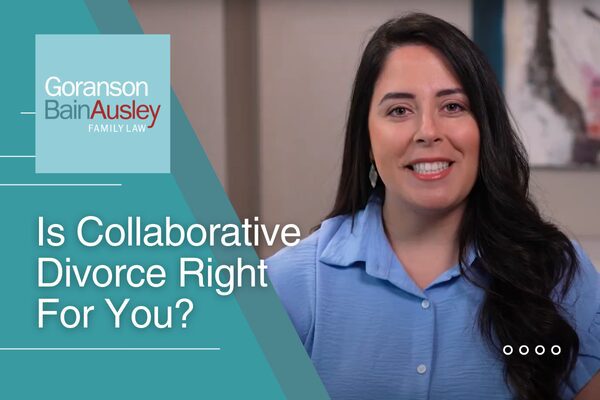
Is Collaborative Divorce Right for You?
Attorney Sarah Milinsky explains what a Collaborative Divorce is, how it's different from a regular courtroom divorce.

Benefits of Collaborative Divorce: How Can it Foster Effective Communication?
Attorney Kelly Fischer explores how Collaborative Divorce benefits couples by fostering more positive and productive communication, which can lead to a better co-parenting relationship.
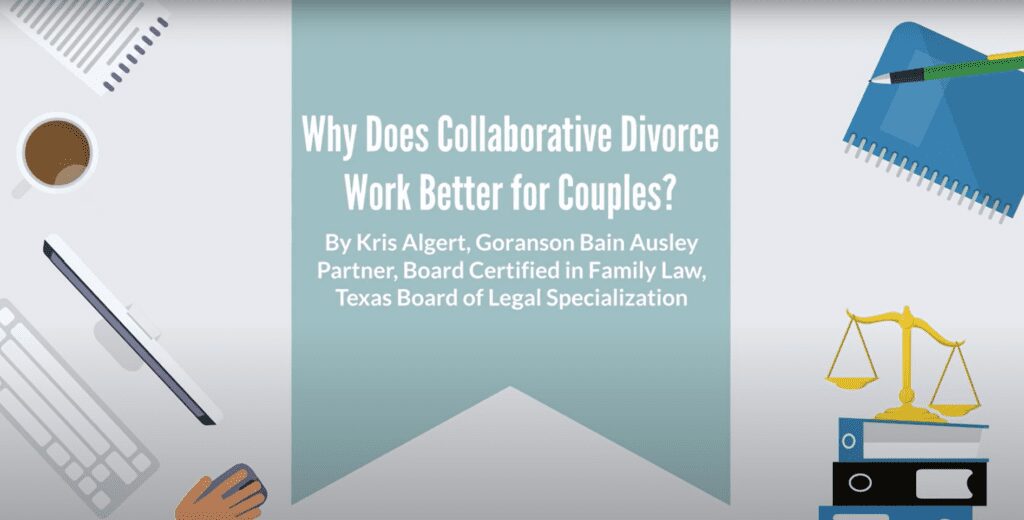
Why Does Collaborative Divorce Work Better for Couples?
In her latest video, Partner Kris Algert explains the benefits of choosing Collaborative Divorce and how it can work better for couples over traditional divorce.
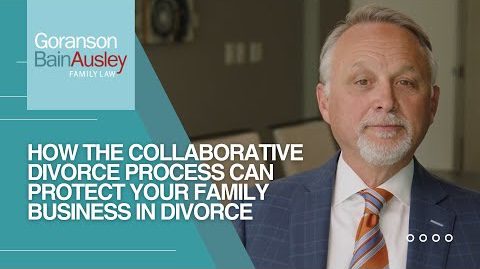
How to Protect Your Family Business in Divorce
Goranson Bain Ausley Partner Kyle Basinger shares the benefits of Collaborative process and why it might be the right option for divorcing business owners.
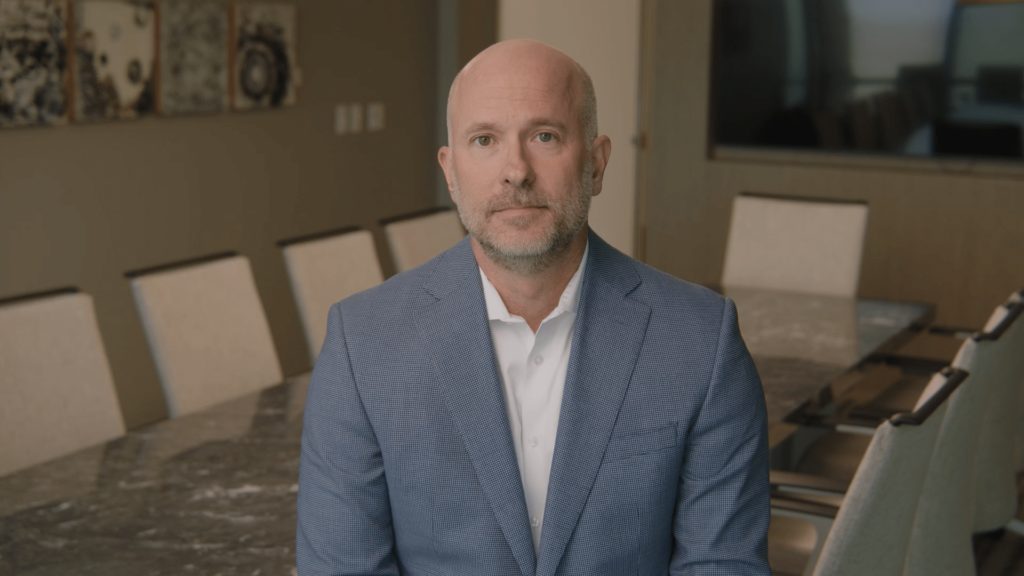
What is the Difference Between a Collaborative vs Litigated Divorce?
Partner Curtis Harrison explains the differences between traditional divorce litigation and a Collaborative Divorce.
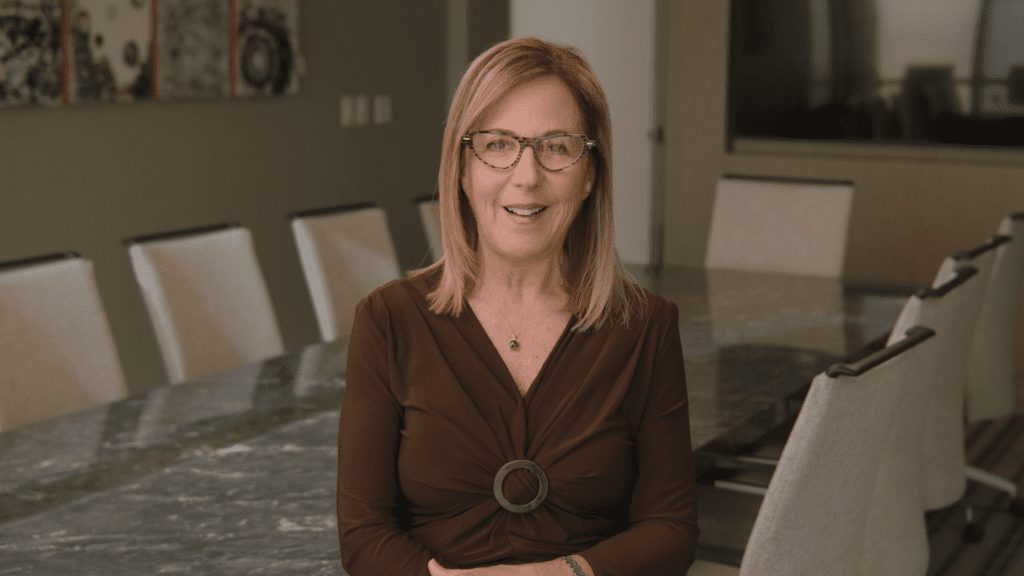
Why Collaborative Divorce is a Good Solution for Divorce After 50
Partner Esther Donald describes the nuances of divorce after 50 and shares why Collaborative Divorce might be the right solution for your family.



Awards & Credentials


- Angeline Lindley Bain 2015 2014 2013 2012 2011 2009 2008
- Hayley Blair 2021 2018
- Kevin Davidson 2025
- Jeff Domen 2025
- Esther R. Donald 2025
- Diana S. Friedman 2017 2016 2015 2013
- Thomas P. Goranson 2011 2009 2008
- Thomas A. Greenwald 2022 2018 2012 2011 2009 2008
- Aimee Pingenot Key 2025 2024 2020 2019 2017
- Beth E. Maultsby 2010
- Kathryn J. Murphy 2024 2023 2020 2019 2018 2017 2010 2009 2008
- Lindsey Obenhaus 2025 2024 2023 2022 2021
- Katie Flowers Samler 2020 2019 2018

- Thomas L. Ausley 1980
- Gary L. Nickelson 1984
- Kathryn J. Murphy 1995
- Kris Algert 1997
- Thomas A. Greenwald 1997
- Eric Robertson 1997
- Kelly Ausley-Flores 2000
- Curtis W. Harrison 2002
- Cindy V. Tisdale 2003
- Jeff Shore 2006
- Clint Westhoff 2006
- Jeff Domen 2009
- Kristal Thomson 2009
- Angel J. Berbarie 2010
- P. Lindley Bain 2012
- Aimee Pingenot Key 2012
- Kevin Davidson 2017
- Charla Davies 2017
- Rob Frazer 2018
- Ryan R. Bauerle 2018
- Hayley Blair 2019
- Lindsey Obenhaus 2019
- Katie Flowers Samler 2019
- Jonathan James 2020
- John J. Kappel 2020
- Chris Nickelson 2021
- Chandler Rice Winslow 2023
- Kristiana Butler 2024
- Cassidy Pearson 2024
- Angelica Rolong Cormier 2024
- Mona Hosseiny Tovar 2025