
Skilled Texas Divorce and Family Law Appellate Attorneys

When a family law judgment has long-term consequences, choosing the right appellate lawyer matters. Family law appeals require a completely different type of legal experience than trial work. Goranson Bain Ausley offers appellate representation that is truly unique in Texas: we are the only family law firm in the state with two attorneys Double Board Certified in Family Law and Civil Appellate Law—a credential held by fewer than 1% of Texas lawyers.
Our appellate team includes Chris Nickelson, John J. Kappel, Clint Westhoff, and Kristiana Butler who have handled appellate matters throughout Texas in complex divorce, property, and child-related cases. Two of our partners were also recognized in the 2026 edition of The Best Lawyers in America® for Appellate Practice in Family Law—independent recognition that reflects the level of knowledge and skill our appellate clients receive.
Whether you are defending a trial outcome or seeking to overturn one, our team provides strategic appellate advice supported by rare experience, advanced legal credentials, and deep familiarity with Texas appellate procedures.
What Is a Family Law Appeal?
An appeal is a request for a higher court—usually a Texas Court of Appeals—to review the trial court’s decision and determine whether a legal or procedural error occurred. The appellate court does not conduct a new trial, but instead reviews the record, evidence, and testimony already presented.
Family law appeals often arise in cases involving:
- child custody
- conservatorship and possession
- property characterization
- division of assets
- complex marital estates
- spousal maintenance
- child support
- prenuptial and postnuptial agreements
Appeals may argue that a judge misapplied Texas family law, failed to properly admit, exclude, or weigh the evidence, abused discretion, or made procedural errors that affected the final judgment.
Video Resources
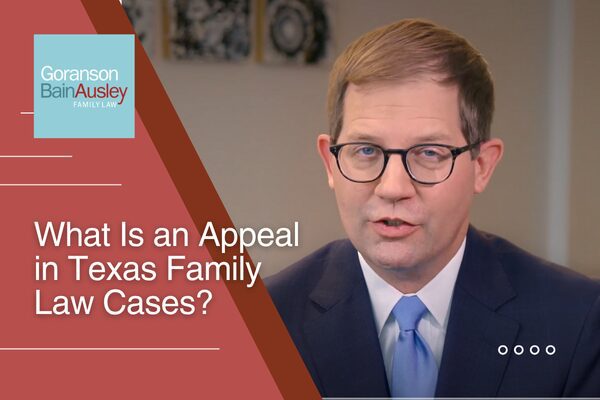
What Is an Appeal in Court?
In this video, board-certified appellate attorney Chris Nickelson explains the key principles of family law appeals.
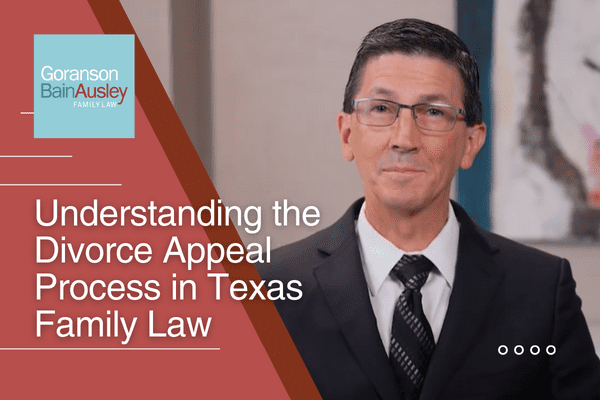
How to File a Divorce Appeal: Understanding the Appeal Process in Texas
Take a deep dive into the divorce appeal process with family law attorney Clint Westhoff, including when you can appeal, how filing a divorce appeal is different from regular litigation, and on what grounds you might be able to mount a successful appeal.
Why GBA for a Texas Divorce Appeal?
Unmatched Board Certification
Only eleven attorneys in Texas hold Double Board Certification in Family Law and Civil Appellate Law. GBA has two. This provides clients and referring lawyers with a strategic advantage when navigating sophisticated appellate issues.
Depth of Family Law Experience
Unlike appellate lawyers who handle occasional family appeals, our appellate practice is rooted in decades of exclusive family law experience across Texas courts.
Appeals Throughout Texas
Our attorneys have handled cases before appellate courts statewide, including the:
- Texas Supreme Court
- Second Court of Appeals (Fort Worth)
- Third Court of Appeals (Austin)
- Fourth Court of Appeals (San Antonio)
- Fifth Court of Appeals (Dallas)
- Seventh Court of Appeals (Amarillo)
- Eighth Court of Appeals (El Paso)
- Ninth Court of Appeals (Beaumont)
- Fourteenth Court of Appeals (Houston)
- and multiple other appellate districts
Family Law Appeals FAQs
Can You Appeal a Divorce Settlement?
In some cases, yes. You may appeal if the trial court committed legal error, misapplied family law, or made decisions unsupported by evidence. We evaluate each situation based on Texas appellate standards.
How Long Do You Have to Appeal a Divorce Ruling in Texas?
In most cases, a notice of appeal must be filed quickly—typically within 30 days of the final decree. It is essential to speak with an appellate lawyer as soon as possible.
Understanding the Divorce Appellate Process
Once grounds for appeal are identified, clients can expect:
- Filing a notice of appeal
- Preparing and reviewing trial court records
- Appellate briefing
- Response briefing (if applicable)
- Oral argument when permitted
- Decision by the appellate court
Most family law appeals take 12-24 months, depending on the court, complexity, and briefing schedule. Original appellate proceedings, seeking immediate relief through a writ of mandamus, prohibition, or habeas corpus, may resolve in a matter of a few weeks or months.
What Types of Family Law Orders Can Be Appealed?
- characterization and valuation of property
- property division
- enforcement rulings
- child custody and conservatorship
- child support
- spousal support
- marital agreements (pre- and post-nuptial)
When to Talk to a Divorce Appeal Attorney
If you believe the trial court:
- misunderstood the facts
- misapplied Texas law
- overlooked key evidence
- abused its discretion
- or issued a decision unsupported by the record
…it may be appropriate to seek appellate review.



Considering an Appeal? We Can Help.
Our appellate team works directly with clients and collaborates with trial counsel—inside or outside the firm—to evaluate potential issues, preserve error, and strategically position cases for appellate consideration.
When the stakes are highest, choose the Texas appellate team with Board Certification and credentials unmatched in family law.
Schedule a consultation.




Awards & Credentials

- Thomas P. Goranson 1997
- Thomas L. Ausley 1997
- Thomas A. Greenwald 2003
- Kathryn J. Murphy 2004
- Eric Robertson 2007
- Kelly Ausley-Flores 2009
- Cindy V. Tisdale 2010
- Kristal Thomson 2014
- Aimee Pingenot Key 2015
- Kris Algert 2017
- P. Lindley Bain 2020
- Ryan R. Bauerle 2022
- Lindsey Obenhaus 2023
- Charla Davies 2024
- John J. Kappel 2024
- Chris Nickelson 2026

- Angeline Lindley Bain 2015 2014 2013 2012 2011 2009 2008
- Hayley Blair 2021 2018
- Kevin Davidson 2025
- Jeff Domen 2025
- Esther R. Donald 2025
- Diana S. Friedman 2017 2016 2015 2013
- Thomas P. Goranson 2011 2009 2008
- Thomas A. Greenwald 2022 2018 2012 2011 2009 2008
- Aimee Pingenot Key 2025 2024 2020 2019 2017
- Beth E. Maultsby 2010
- Kathryn J. Murphy 2024 2023 2020 2019 2018 2017 2010 2009 2008
- Lindsey Obenhaus 2025 2024 2023 2022 2021
- Katie Flowers Samler 2020 2019 2018

- Thomas L. Ausley 1980
- Gary L. Nickelson 1984
- Kathryn J. Murphy 1995
- Kris Algert 1997
- Thomas A. Greenwald 1997
- Eric Robertson 1997
- Kelly Ausley-Flores 2000
- Curtis W. Harrison 2002
- Cindy V. Tisdale 2003
- Jeff Shore 2006
- Clint Westhoff 2006
- Jeff Domen 2009
- Kristal Thomson 2009
- Angel J. Berbarie 2010
- P. Lindley Bain 2012
- Aimee Pingenot Key 2012
- Kevin Davidson 2017
- Charla Davies 2017
- Rob Frazer 2018
- Ryan R. Bauerle 2018
- Hayley Blair 2019
- Lindsey Obenhaus 2019
- Katie Flowers Samler 2019
- Jonathan James 2020
- John J. Kappel 2020
- Chris Nickelson 2021
- Chandler Rice Winslow 2023
- Kristiana Butler 2024
- Cassidy Pearson 2024
- Angelica Rolong Cormier 2024
- Mona Hosseiny Tovar 2025